Despite the global acceleration in research and innovation investment, North Macedonia remains far behind both the European Union average and many regional peers when it comes to R&D investment and strategic prioritization.
According to the latest data, Gross Domestic Expenditure on R&D (GERD) in North Macedonia stands at approximately 0.37–0.40% of GDP in 2023, a modest increase from previous years but still extremely low by international standards.
By comparison, the European Union’s R&D intensity, the share of R&D spending relative to GDP, was around 2.2% in 2024, with several EU member states comfortably above the 3% threshold set by the European Council. This means that North Macedonia’s R&D commitment is less than one-fifth of the EU average and a fraction of what leading knowledge economies invest.
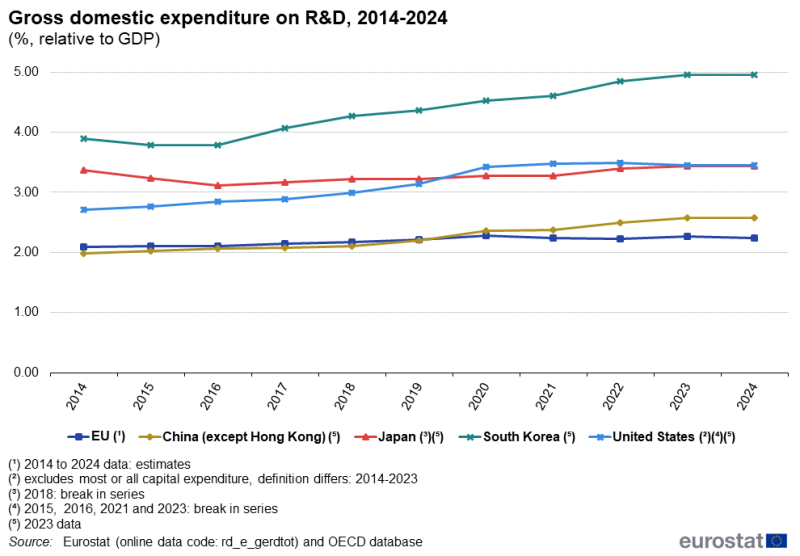
Just for comparisons: Table above shows that South Korea currently leading the world with an impressive 5% of its GDP dedicated to R&D. This level of commitment has turned the country into a global powerhouse for technology, innovation and industrial advancement. The United States and Japan follow with around 3.5% each. Both countries continue to invest heavily in scientific research, advanced manufacturing and cutting-edge technologies, maintaining their positions as leaders in global innovation. China has now surpassed the European Union by reaching 2.5% of GDP in R&D spending. This rapid growth reflects China’s long-term strategy to strengthen its technological capabilities and reduce dependence on foreign innovation.
At the bottom of this group is the European Union with 2.2%. Although the EU is a large economic bloc, its R&D intensity remains lower than key global competitors. This gap highlights the urgent need for stronger and more coordinated investment in science, technology and innovation if the EU aims to stay competitive in a rapidly changing global landscape.
R&D spending in North Macedonia
R&D spending in North Macedonia is still below 0.5% of GDP which shows that the country constantly underfunds sectors based on knowledge and innovation. Other areas such as infrastructure or social transfers receive far more attention. There is no clear policy or concrete target to increase R&D investment even though international institutions have made this recommendation for years.
Government policies have also failed to encourage the private sector to invest in research and innovation. This shows deeper problems in industrial policy and a lack of willingness to create a system where tax, financial and innovation policies work together to stimulate public and private cooperation in R&D.
Long-term planning is weak and implementation is even weaker. Although strategies like the Smart Specialisation Strategy show that the country understands its priorities, these documents often remain unimplemented or underfunded. They lack strong monitoring mechanisms and long-term political commitment which prevents real progress in building an effective R&D system.
North Macedonia is at a critical crossroads. Without urgent political commitment to increase R&D spending to at least 2% of GDP and without structural reforms that strengthen cooperation between academia, business and government, the country will continue falling behind its neighbours and the European Union.
Politicians need to move beyond superficial messages about economic growth and focus on real investment in science, technology and innovation. Without strong R&D infrastructure and adequate funding, economic competitiveness, qualified jobs and technological independence will remain out of reach.
Read more on the following link: https://ec.europa.eu/eurostat/statistics-explained/index.php?title=R%26D_expenditure